

When someone buys a security system, they're not just purchasing cameras, sensors, or an alarm panel. They're buying peace of mind. But that peace of mind depends on what happens after an alarm goes off.
That's where central station monitoring comes in.
A central station is the team behind the scenes that receives alarm signals, verifies emergencies, and contacts the appropriate emergency responders. If the monitoring center isn't reliable, even the best security system in the world can fall short when it matters most.
Whether you're an alarm dealer looking for a trusted monitoring partner or a business owner evaluating security providers, asking the right questions upfront can save you headaches and potentially save lives.
Here are seven questions every dealer should ask before choosing a central station.
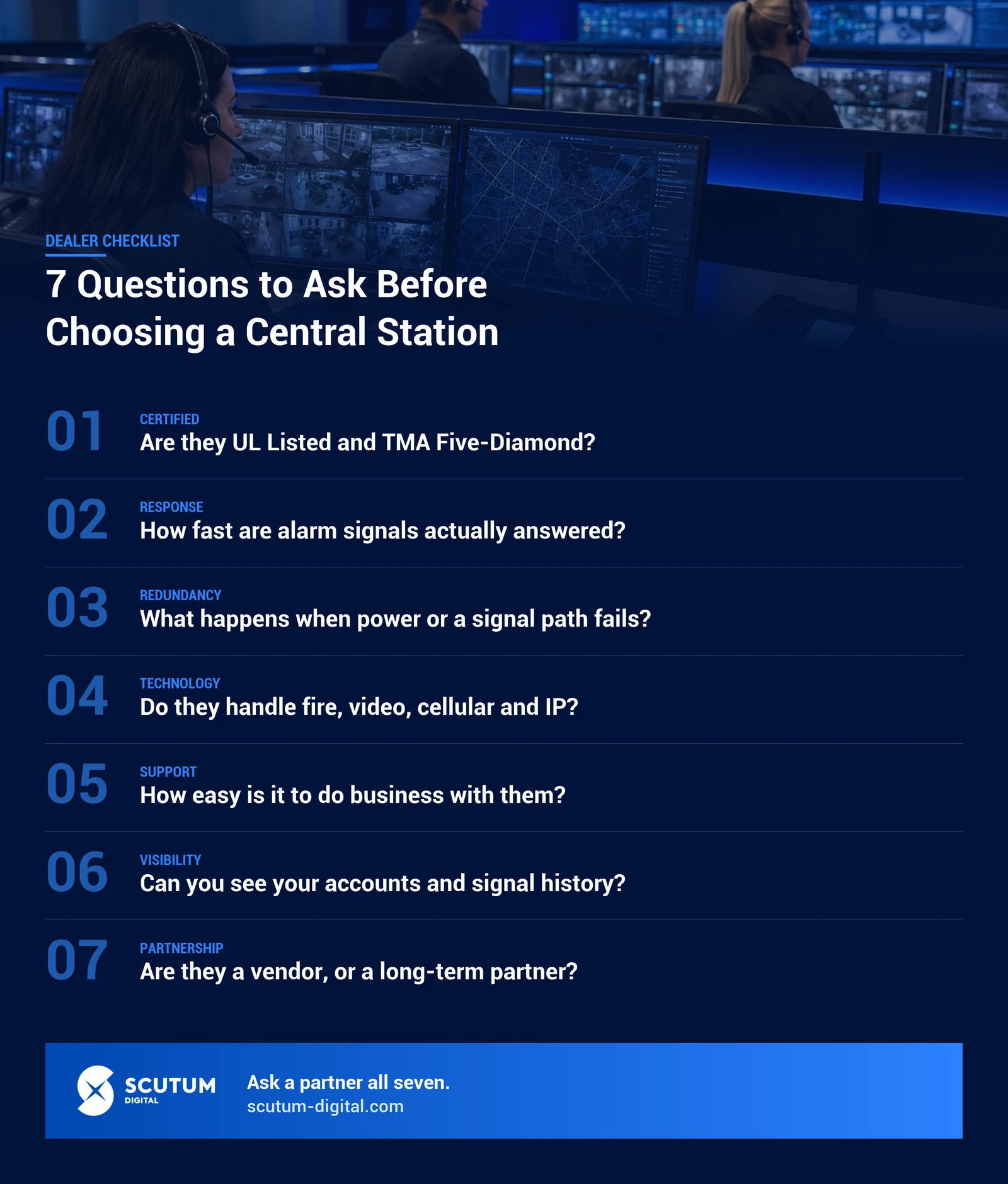
1. Is the Central Station UL Listed and TMA Five Diamond Certified?
Not all monitoring centers operate at the same standard.
When evaluating a provider, start by asking about their certifications.
A reputable central station monitoring provider should be:
- UL Listed: The facility has met rigorous safety and operational standards.
- TMA Five Diamond Certified: Monitoring center operators complete advanced professional training and ongoing education.
Think of these certifications like choosing a hospital. You want trained professionals working in a facility that has been inspected and held to high standards, not simply the lowest-cost option.
These certifications demonstrate that the monitoring center has invested in quality, reliability, and ongoing operator education.
Why it matters: Certifications help ensure your alarm signals are handled by trained professionals following established industry best practices.
2. How Quickly Do They Respond to Alarm Signals?
Imagine a burglary alarm activates at 2:15 a.m.
Every second that passes before someone responds can increase the risk of property damage, theft, or danger to occupants.
Ask potential monitoring providers:
- How quickly are incoming alarm signals answered?
- Are operators available 24 hours a day, 365 days a year?
- Are response times consistently monitored and measured?
Fast response isn't just a marketing claim. It should be something the provider actively tracks and works to improve.
A quality monitoring center should be transparent about its performance and committed to minimizing response times.
Real-world example: If two monitoring centers receive the same burglary alarm, but one consistently answers signals faster, emergency services may be dispatched sooner. Those extra moments can make a meaningful difference during an active emergency.
3. What Happens if the Monitoring Center Loses Power or Internet?
It's a question many people never think to ask.
Storms, cyberattacks, equipment failures, and natural disasters can all impact a monitoring center.
A dependable central station monitoring provider should have multiple layers of redundancy, including:
- Backup generators
- Battery backup systems
- Multiple internet connections
- Redundant communication paths
- Secondary monitoring facilities in different geographic locations
The goal is simple: If one system fails, another immediately takes over.
Your customers shouldn't lose protection simply because one building experiences a problem.
Why it matters: True reliability isn't measured on a normal day. It's measured during the unexpected.
4. Can They Support Today's Security Technology?
Security has changed dramatically over the last decade.
Today's monitoring centers often handle much more than traditional burglar alarms.
Ask what technologies they support, including:
- Intrusion alarms
- Fire alarm monitoring
- Cellular communicators
- IP monitoring
- Dual-path communication
- Video alarm verification
- Mobile app integrations
- Interactive smart security services
A provider with modern technology is better equipped to support your business today and adapt as technology continues to evolve.
Why it matters: If you're an alarm dealer, this flexibility also allows you to offer more services to your customers without changing monitoring partners.
5. How Easy Is It to Do Business With Them?
Technology is only part of the relationship.
You're also choosing a company you'll likely work with for years.
Ask questions like:
- Is technical support easy to reach?
- Will you have a dedicated account manager?
- How simple is it to add or transfer accounts?
- What does onboarding look like?
- Do they provide training for dealers and technicians?
A monitoring provider should make your business easier, not create additional work.
The best partners act as an extension of your own team.
6. What Kind of Reporting and Account Management Tools Do They Offer?
Good monitoring isn't just about answering alarms.
It's also about giving dealers and customers visibility into what's happening.
Modern central station monitoring providers often offer tools such as:
- Online account management portals
- Activity reports
- Signal history
- Test mode management
- User management
- Dealer dashboards
These tools can simplify everyday operations, reduce administrative work, and help resolve customer questions quickly.
Why it matters: For growing alarm companies, efficient account management can save countless hours over the course of a year.
7. Are You Choosing a Vendor or a Long-Term Partner?
This may be the most important question of all.
Price is important, but it shouldn't be the only deciding factor.
A great central station becomes part of your business. Consider everything the monitoring center may be responsible for:
- Answering your customers' emergency calls
- Representing your brand during stressful situations
- Supporting your technicians
- Helping your business grow
Before choosing a provider, ask yourself:
- Do they communicate well?
- Are they responsive?
- Do they invest in technology?
- Do they understand your business goals?
- Can they grow alongside your company?
The right monitoring partner helps you build trust with your customers for years to come.
Why Choosing the Right Central Station Matters
Most people never think about their monitoring center until they need it.
When an alarm activates, everything depends on the people and technology behind the scenes.
That's why selecting a central station monitoring provider deserves careful consideration.
By asking these seven questions, you'll gain a much clearer understanding of:
- How the provider operates
- What level of service they deliver
- What technology and resources they offer
- Whether they can support your business as it grows
- How prepared they are to protect your customers when it matters most
The best monitoring partner isn't necessarily the cheapest.
It's the one you can trust when seconds count.
Partner with Scutum Digital
At Scutum Digital, we believe exceptional central station monitoring is built on three things:
- Experienced professionals
- Advanced monitoring technology
- A commitment to outstanding customer service
Whether you're an independent alarm dealer looking for a dependable monitoring partner or a business seeking reliable protection, our team is here to help.
Our monitoring solutions are designed to deliver fast response, dependable service, and the confidence that every alarm is handled with care.
Ready to learn more? Contact Scutum Digital today to discover how our central station monitoring services can support your business and protect what matters most.
Frequently Asked Questions
What is central station monitoring?
Central station monitoring is a professional service where trained operators monitor alarm signals 24/7. When an alarm is triggered, the monitoring center verifies the event and contacts the appropriate emergency responders or designated contacts.
Why is professional monitoring better than self-monitoring?
Self-monitoring relies on you receiving and responding to alerts. Professional monitoring ensures trained operators are always available, even if you're asleep, traveling, or unable to answer your phone.
What certifications should a central station have?
Look for a provider that is UL Listed and TMA Five Diamond Certified. These certifications demonstrate adherence to high operational standards and ongoing operator training.
Can one central station monitor fire, burglary, and video alarms?
Yes. Many modern central stations monitor:
- Intrusion alarms
- Fire alarms
- Video verification systems
- Access control
- Other connected security technologies
These systems can be supported from a single monitoring center, depending on the provider's capabilities.