

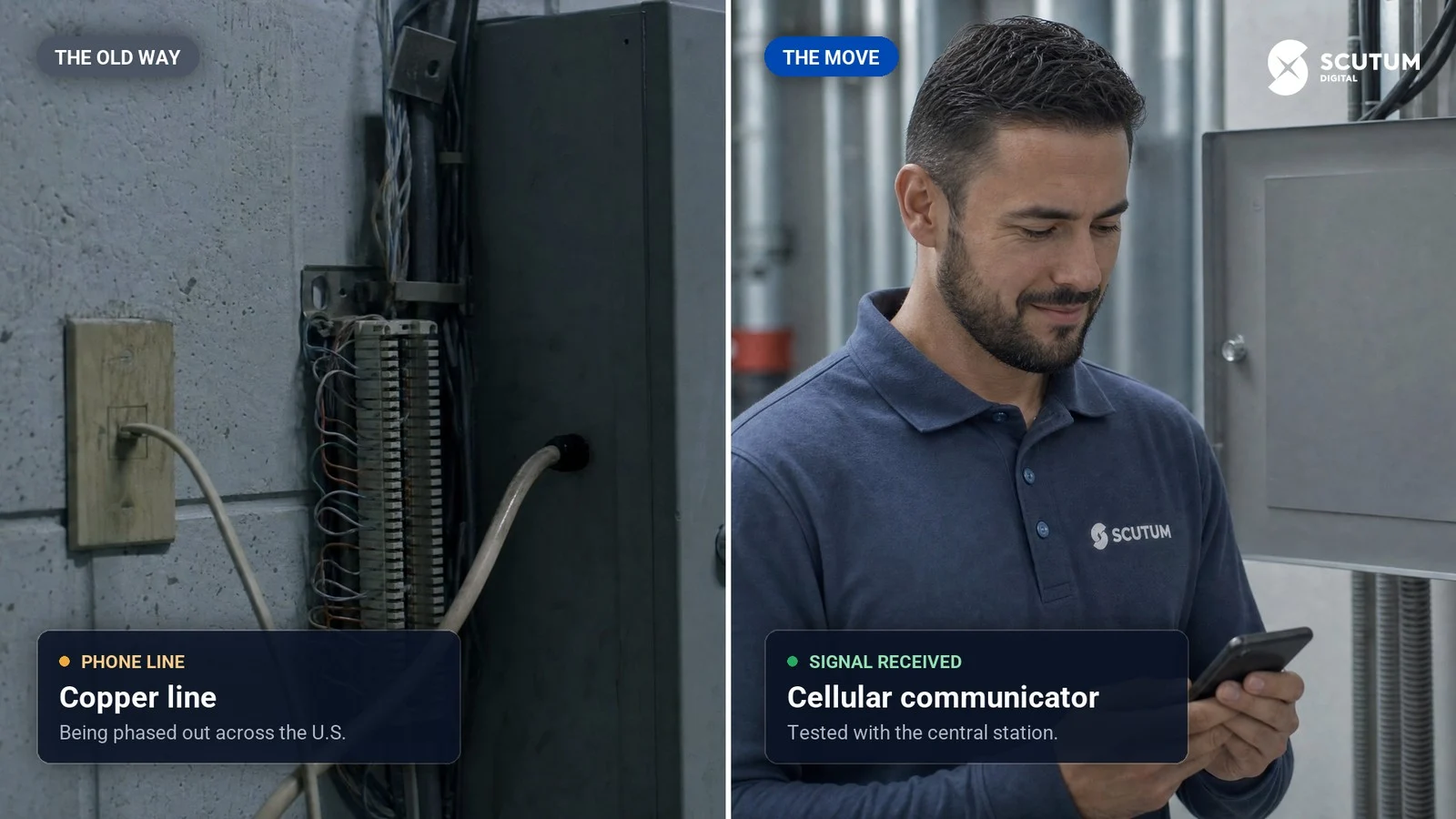
Traditional copper phone service is being phased out across the United States as telecommunications providers continue moving customers to fiber, wireless, and IP-based services.
For alarm dealers, that transition matters because many existing fire alarm, security, elevator, and other monitored systems still rely on traditional telephone lines to communicate.
There is no single nationwide date when every copper line will disappear. The transition is happening gradually and varies by carrier and location. That makes it important for dealers to identify affected accounts before a change in telephone service creates a communication problem.
Still have accounts on phone lines? Let’s plan the move.
What Is Happening to Traditional Phone Lines?
POTS, or Plain Old Telephone Service, refers to traditional analog telephone service historically delivered over copper infrastructure.
Telecommunications providers have been transitioning away from these legacy networks for years as they invest in newer technologies.
That transition continues to accelerate.
In March 2026, the Federal Communications Commission adopted its Network and Services Modernization Order, which changed federal requirements associated with network changes and service discontinuances. Among other changes, the FCC eliminated certain network change disclosure filing requirements and revised portions of the process carriers follow when discontinuing legacy services.
At the same time, major telecommunications providers continue moving customers away from traditional copper infrastructure.
AT&T, for example, has stated its goal of exiting the large majority of its legacy copper network footprint by the end of 2029 and began discontinuing legacy services in certain areas in 2026.
This does not mean every traditional telephone line will disappear at the same time. Copper retirement is occurring gradually, and the timing can vary considerably by carrier, service area, and individual account.
For alarm dealers, that creates an important challenge: customers may receive information about changes to their telephone service before their alarm company knows anything has changed.
Why This Matters for Alarm Systems
A telephone line connected to an alarm panel is more than just a phone number. It may be the communication path the panel uses to transmit alarm, trouble, and supervisory signals to the central station.
When a customer replaces traditional telephone service with another type of service, the alarm system should be evaluated to make sure its communication path remains reliable and compatible.
Several issues can arise.
Communication compatibility. Older alarm communicators were designed to transmit signals using traditional analog telephone service. Some replacement telephone technologies may handle those signals differently or may not be appropriate for alarm communications.
Power and network dependencies. Traditional telephone service and newer IP-based or locally powered communication services can have different power and infrastructure requirements. Routers, modems, adapters, and other equipment may depend on power at the protected premises.
Changes can happen without the alarm dealer knowing. A customer may change telephone providers or service plans without realizing the change could affect an alarm system. The alarm panel itself may continue operating normally even if its communication path has changed or is no longer functioning as intended.
That is why communication paths should be reviewed and tested whenever telephone service changes.
What About Fire Alarm Systems?
Fire alarm communication requirements deserve particular attention because the applicable requirements can depend on several factors, including the system, communication technology, adopted code edition, and local Authority Having Jurisdiction (AHJ).
NFPA 72 has evolved over time to recognize communication technologies beyond traditional telephone lines. Modern fire alarm systems may use cellular, IP, radio, or other approved communication methods when the equipment and configuration meet applicable requirements.
However, replacing a traditional telephone line with another service should not be treated as a simple telephone-company change.
Dealers should verify that the proposed communication method is appropriate for the fire alarm system, compatible with the equipment, and acceptable under the codes and standards adopted in that jurisdiction.
The local AHJ has an important role in determining what is acceptable for a specific installation.
When there is any uncertainty, confirm the requirements before making the change.
Communication Options for Alarm Dealers
There is no single replacement that is right for every account. The appropriate communication method depends on the existing system, application, local requirements, available infrastructure, and customer needs.
Cellular Communication
Cellular communicators provide an alternative to traditional telephone lines without relying on the customer's wired telephone service.
They are widely used for intrusion and other monitored security applications, and listed equipment may also be used for fire alarm communications when permitted by the applicable requirements and AHJ.
When selecting cellular equipment, dealers should consider current network compatibility, manufacturer support, and the expected service life of the technology.
Cellular and IP Communication
Some systems use both cellular and IP communications to provide multiple available communication paths.
This can be useful for commercial, fire, and other applications where communication reliability is especially important.
The appropriate configuration should always be based on the system requirements and applicable codes.
IP Communication
IP communicators can transmit alarm signals through a network connection rather than a traditional telephone line.
They may be appropriate for facilities with reliable network infrastructure and compatible alarm equipment.
Dealers should consider network availability, power backup, supervision, cybersecurity, and other requirements when designing an IP-based alarm communication solution.
Radio Communication
Radio-based technologies, including private wireless mesh networks, may provide another option in areas where the appropriate infrastructure is available.
These systems can be particularly useful when cellular or wired network connectivity presents challenges.
Managed Telephone Replacement Solutions
Some equipment still requires an analog-style telephone connection.
In those situations, specialized managed telephone replacement technologies may provide an option, depending on the equipment and application.
It is important to distinguish a solution designed and documented for alarm, fire, elevator, or other critical communications from a standard consumer telephone adapter.
Dealers should verify compatibility, listing requirements, backup power, supervision, and AHJ acceptance when applicable.
System or Panel Upgrades
In some cases, replacing or upgrading older equipment may be more practical than adapting a legacy communicator.
An upgrade can also provide an opportunity to add newer communication capabilities, remote access, improved supervision, and other features.
The right approach depends on the age and condition of the existing equipment, customer requirements, and the cost of maintaining the legacy system.
How Dealers Can Prepare
The transition away from traditional telephone service does not need to become an emergency.
Dealers can take several steps now to identify affected customers and develop an organized migration plan.
- Identify accounts using telephone lines. Review your monitored accounts and determine which systems still communicate using traditional telephone service. If that information is not readily available, work with your central station to determine what can be identified from account and signal information.
- Prioritize critical systems. Consider addressing life-safety and other critical applications first, followed by commercial security and other monitored systems. Priorities should reflect the application, customer needs, equipment condition, and communication requirements.
- Review the entire system. A communication upgrade is also an opportunity to review the condition of the existing alarm equipment. For an older system, it may make more sense to discuss a broader upgrade rather than simply replacing the communication path.
- Discuss communication changes with customers. Customers may not realize that changing their telephone service could affect their alarm system. Educating them before they make a change can help prevent communication issues and unexpected service calls.
- Test every upgraded account. Whenever a communication path is changed, follow the appropriate testing procedures and confirm that signals are being received correctly by the central station before completing the service visit.
- Plan for ongoing technology changes. The transition away from copper is one example of how communications technology continues to evolve. Choosing current, supported equipment and maintaining accurate account information can make future technology transitions easier to manage.
An Opportunity to Expand Your Services
For dealers, the transition away from traditional telephone lines is also an opportunity to review older accounts and modernize the services those customers receive.
A communication upgrade may allow a dealer to offer additional services such as:
- Cellular or IP alarm communication
- Enhanced communication supervision
- Remote system access
- Customer apps and notifications
- Additional monitored services
Depending on the solution, these services may also create opportunities for additional recurring monthly revenue.
The goal should not simply be replacing one communication path with another. It is an opportunity to make sure the customer's system is using a reliable, supported communication method that meets their current needs.
How Scutum Digital Can Help
Scutum Digital has provided wholesale monitoring services to alarm dealers since 1981 from our UL Listed, TMA Five Diamond Certified central station.
We support a range of modern alarm communication technologies and platforms, allowing dealers to migrate accounts away from traditional telephone lines while maintaining professional central station monitoring.
Our team can also assist dealers with account setup, testing, and technical questions during communication upgrades.
Through the Scutum Digital dealer portal and app, dealers can manage accounts, place systems on test, review signals, and confirm communication with the central station while technicians are on site.
For dealers managing a larger group of legacy accounts, identifying which customers still rely on traditional telephone communication is an important first step toward developing a migration plan.
Talk to Scutum Digital
If you are unsure which of your monitored accounts may still rely on traditional telephone lines, Scutum Digital can help you review your accounts and plan the next steps.
We can also work with your team as systems are migrated to modern communication technologies and help confirm that signals are communicating properly with the central station.
Call (866) 494-6414 or email info@scutum-digital.com.