

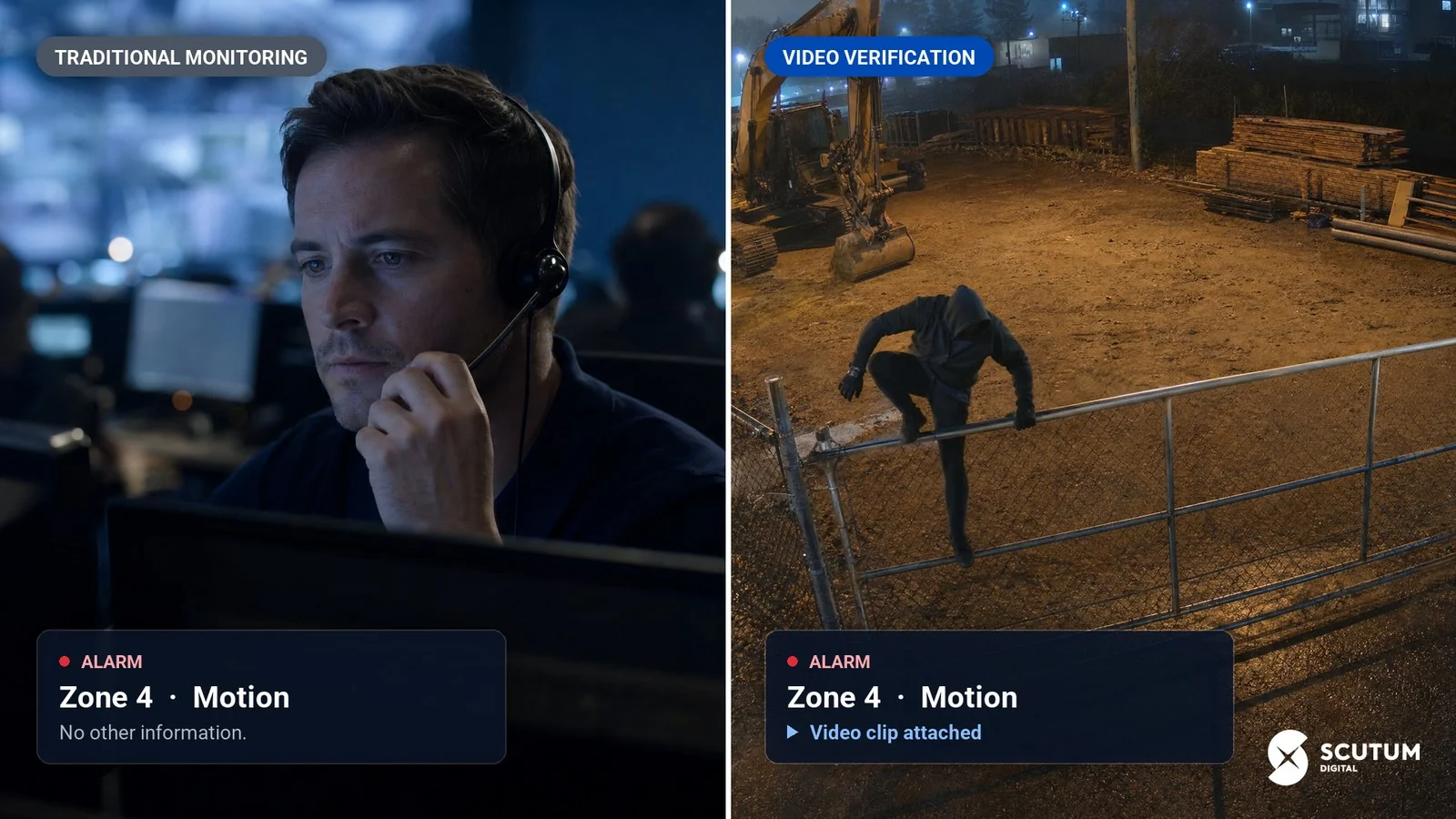
Traditional alarm monitoring and video verification serve the same basic purpose: helping protect a property when an alarm event occurs. The key difference is the information available to the central station operator when that event happens.
Consider a motion alarm at a contractor's yard in the middle of the night.
With traditional monitoring, an operator receives an alarm signal identifying the account, device, and zone. The operator follows the account's established procedures, which may include contacting the premises, notifying a key holder, and requesting police response.
With video verification, the operator can also receive video associated with the alarm. Instead of responding to the signal alone, the operator may be able to see what caused it.
If the video shows individuals entering a secured area, for example, the operator can provide additional information about what is happening when following the appropriate response procedures. If the site is equipped for audio communication, the operator may also be able to issue a live warning.
That additional context is what makes video verification different.
Same alarm, different outcome: traditional monitoring and video verification, side by side.
What Traditional Alarm Monitoring Does Well
Traditional intrusion monitoring is built around alarm signals. A door contact opens, a motion detector activates, or another device triggers the alarm panel. The signal is transmitted to the central station, where a trained operator follows the account's established notification and dispatch procedures.
It is a proven model that remains an important part of professional security.
The challenge with intrusion alarms is that an alarm signal alone does not always tell an operator what caused the activation. A motion detector can indicate activity within an area, for example, but it cannot necessarily tell the operator whether that activity represents an actual security threat.
False alarms have long been a challenge for the security industry, customers, monitoring centers, and public safety agencies. Depending on the jurisdiction, repeated false alarms may result in fines, permit requirements, or different response procedures.
Alarm response policies can also vary significantly between jurisdictions. Some may require additional verification before law enforcement is dispatched to certain types of intrusion alarms.
For dealers, understanding local requirements and designing systems accordingly is an important part of providing effective security solutions.
What Is Video Verification?
Video verification connects an alarm event with visual information from the protected property.
A typical video verification event may work like this:
- An alarm is triggered by a panel zone, sensor, or video analytics.
- The central station receives the alarm along with an associated video clip or access to live video.
- A trained operator reviews the available video to help determine what may have caused the event.
- If suspicious activity is observed, the operator follows the account's established response procedures and can provide additional information when contacting the appropriate parties.
- When supported by the system, the operator may also use live audio to communicate with individuals at the property.
- Alarm activity, operator actions, timestamps, and available video can be documented as part of the event record.
The important difference is context.
Instead of responding only to an alarm signal, the operator has additional information that can help determine what may be happening at the property.
Why Verification Matters
Video verification gives operators another source of information when evaluating an intrusion alarm.
For example, instead of receiving only a motion alarm from a commercial property, an operator may be able to see that an individual has entered a fenced area and provide additional information about what is happening.
Verification can also help operators identify events that do not appear to represent a security threat, potentially reducing unnecessary dispatches and helping customers address recurring false alarm issues.
The advantage is not simply having cameras. It is giving the operator more context when an alarm occurs.
Understanding AVS-01
The security industry has developed a more standardized way to communicate information about intrusion alarm events to public safety agencies.
ANSI/TMA-AVS-01, the Alarm Validation Scoring standard, establishes a consistent method for classifying intrusion alarm events based on the information available to the monitoring center.
The standard includes five levels:
- Level 0: No call for service
- Level 1: Call for service with limited to no additional information
- Level 2: Call for service with confirmed or highly probable human presence, with intent unknown
- Level 3: Call for service with a confirmed threat to property
- Level 4: Call for service with a confirmed threat to life
Monitoring centers can use information collected during the alarm confirmation process, along with other available data, to determine the appropriate alarm level.
The purpose of AVS-01 is to provide public safety agencies with more consistent information that can assist with situational awareness, resource allocation, and call-for-service prioritization.
For alarm dealers, the takeaway is straightforward: the more reliable information a monitoring center has about an intrusion event, the more accurately that event can be communicated to public safety.
Where Traditional Monitoring and Video Verification Fit
Video verification does not replace traditional alarm monitoring. The two can complement one another depending on the property, application, and security risks involved.
Traditional monitoring remains an important solution for applications such as:
- Fire and sprinkler monitoring
- Elevator monitoring
- Medical and personal emergency response
- Holdup and duress
- Residential and commercial intrusion systems
Video verification can be particularly useful for locations such as:
- Construction sites
- Contractor yards
- Equipment storage facilities
- Auto dealerships
- Self-storage facilities
- Distribution centers and warehouses
- Manufacturing and industrial properties
- Other outdoor or higher-risk commercial sites
It may also be worth considering for customers experiencing repeated false alarms or operating in jurisdictions with specific alarm verification requirements.
In many applications, the two technologies can work together. The alarm system continues to protect the building, while video provides additional information from areas such as entrances, parking lots, yards, and perimeters.
What Video Verification Can Mean for Dealers
For alarm dealers, video verification can expand the services available to both existing and prospective customers.
Additional recurring monthly revenue. Video verification can be offered as an additional monitored service, creating an opportunity for dealers to increase recurring monthly revenue while providing additional value to customers.
More options for challenging properties. Properties such as construction sites, equipment yards, and industrial facilities can present unique security challenges. Video verification provides operators with visual information that can help them better understand an alarm event.
Help with false alarm challenges. When operators have additional information about what caused an alarm, they may be better equipped to identify events that do not require further action. This can help customers manage recurring false alarm issues and unnecessary dispatches.
Greater importance of system design. Effective video verification depends on more than installing cameras. Camera placement, lighting, field of view, analytics, connectivity, and image quality can all affect an operator's ability to evaluate an event. A camera installed primarily to record video for later review may not necessarily be positioned or configured appropriately for real-time detection and verification.
Clear customer expectations. Customers should understand what service they are purchasing. Video verification generally means an operator reviews video associated with an alarm event. It does not necessarily mean someone is continuously watching the property. Setting those expectations clearly helps customers understand both the capabilities and limitations of the service.
Video Verification with Scutum Digital
Scutum Digital provides wholesale monitoring services for alarm dealers, allowing dealers to maintain their customer relationships and accounts while using Scutum Digital's monitoring infrastructure.
We have supported alarm dealers since 1981 from our UL Listed, TMA Five Diamond Certified central station.
Our video monitoring capabilities include:
- Video verification associated with alarm events
- Video analytics for intrusion detection and deterrence
- Loitering detection and response
- Offsite video recording
- Live operator response
- Audio talk-down when supported by the site's equipment
Scutum Digital also supports video-monitored mobile security towers for temporary, remote, and other applications where permanent security infrastructure may not be practical.
For dealers with customers who already have compatible video systems in place, adding video verification may provide an opportunity to expand monitoring services without replacing the customer's entire security system.
Talk to Scutum Digital
Have a customer dealing with repeated false alarms, theft, trespassing, or another difficult security challenge?
Talk to Scutum Digital about whether video verification could be a good fit for the property and what may be required to add it to your monitoring services.
Call (866) 494-6414 or email info@scutum-digital.com.